White Cheetahs With Blue Eyes Scientific Name for White Cheetahs
| Cheetah [1] Temporal range: Late Pliocene to Recent | |
|---|---|
 | |
| Conservation condition | |
| | |
| Scientific nomenclature | |
| Kingdom: | Animalia |
| Phylum: | Chordata |
| Grade: | Mammalia |
| Lodge: | Carnivora |
| Family: | Felidae |
| Genus: | Acinonyx |
| Species: | A. jubatus |
| Binomial proper name | |
| Acinonyx jubatus (Schreber, 1775) | |
| Type species | |
| Acinonyx venator Brookes, 1828 (= Felis jubata, Schreber, 1775) past monotypy | |
| Subspecies | |
| Meet text. | |
 | |
| The range of the cheetah | |
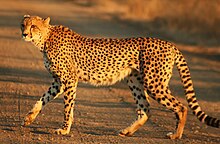
The cheetah (Acinonyx jubatus) is a large feline (family Felidae, subfamily Felinae) inhabiting most of Africa and parts of Iran. It is the simply extant fellow member of the genus Acinonyx. The cheetah can run faster than whatsoever other country brute— as fast as 112 to 120 km/h (seventy to 75 mph) [3] [iv] [5] [6] [seven] [8] in brusque bursts covering distances up to 500 g (1,600 ft), and has the ability to accelerate from 0 to 100 km/h (62 mph) in 3 seconds. [9]
The cheetah is a unique felid, with its closest living relatives beingness the puma and jaguarundi of the Americas. This true cat is notable for modifications in the species' paws, being i of the few felids with just semi-retractable claws. [ten]
Its main hunting strategy is to run down swift prey such as various antelope species and hares. About every facet of the cheetah'south anatomy has evolved to maximise its success in the chase, the effect of an evolutionary arms race with its prey. Due to this specialisation, yet, the cheetah is poorly equipped to defend itself against other big predators, with speed being its chief ways of defence.
In the wild, the cheetah is a prolific breeder, with upwards to nine cubs in a litter. The majority of cubs exercise not survive to adulthood, mainly as a issue of depredation from other predators. The charge per unit of cub bloodshed varies from area to area, from 50% to 75%, [11] and in farthermost cases such as the Serengeti ecosystem, upwardly to ninety%. Cheetahs are notoriously poor breeders in captivity, though several organizations, such as the De Wildt Cheetah and Wild fauna Centre, have succeeded in breeding high numbers of cubs.
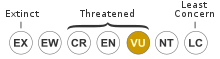
The cheetah is listed as vulnerable, facing various threats including competition with and predation past other carnivores, a gene puddle with very low variability, and persecution by mankind. It is a charismatic species and many captive cats are "ambassadors" for their species and wildlife conservation in general.
Etymology [edit]
The word "cheetah" is derived from the Sanskrit word citrakāyaḥ , significant "variegated", from the Hindi 'चीता' (cītā). [12]
Genetics, development, and classification [edit]

Tanzanian cheetah (Acinonyx jubatus raineyii)

Illustration of Asiatic cheetah (Acinonyx jubatus venaticus)

The genus name, Acinonyx, means "no-motion-hook" in Greek, while the species name, jubatus, ways "maned" or "crested" in Latin, a reference to the dorsal crest found in chetah cubs. [xiii]
The chetah has unusually low genetic variability. This is accompanied by a very low sperm count, motility, and deformed flagella. [14] Pare grafts betwixt unrelated cheetahs illustrate the former point, in that there is no rejection of the donor skin. Information technology is thought that the species went through a prolonged menstruum of inbreeding following a genetic bottleneck during the last ice age. This suggests that genetic monomorphism did not preclude the cheetah from flourishing across two continents for thousands of years. [xv]
The cheetah probable evolved in Africa during the Miocene epoch (26 one thousand thousand to vii.five meg years ago), before migrating to Asia. Recent research has placed the last common ancestor of all existing populations as living in Asia 11 million years ago, which may lead to revision and refinement of existing ideas most chetah development. [xvi]
The now-extinct species include Acinonyx pardinensis (Pliocene epoch), much larger than the mod cheetah and found in Europe, India, and China; and Acinonyx intermedius (mid-Pleistocene menses), found over the same range. The extinct genus Miracinonyx was extremely cheetah-like, but contempo DNA assay has shown that Miracinonyx inexpectatus, Miracinonyx studeri, and Miracinonyx trumani (early to tardily Pleistocene epoch), found in North America and called the "North American cheetah" are not truthful cheetahs, instead beingness close relatives to the cougar. [17]
Subspecies [edit]
Although many sources list half dozen or more subspecies of cheetah, the taxonomic condition of well-nigh of these subspecies is unresolved. Acinonyx rex—the male monarch cheetah—was abandoned as a subspecies afterwards it was discovered that the variation was acquired by a single recessive cistron. The subspecies Acinonyx jubatus guttatus, the woolly cheetah, may also have been a variation due to a recessive cistron. Some of the nearly ordinarily recognized subspecies include: [18]
- Asiatic cheetah (Acinonyx jubatus venaticus): Asia (Transitional islamic state of afghanistan, Bangladesh, India, Iran, Republic of iraq, Israel, Jordan, Oman, Pakistan, Kingdom of saudi arabia, Syria, Russia) Current range is in Islamic republic of iran. Extinct in other Asian countries.
- Northwest African cheetah (Acinonyx jubatus hecki): Northwest Africa (Algeria, Mali, Mauritania, Morocco, Niger, Tunisia) and western Africa (Benin, Burkina Faso, Ghana, Republic of mali, Islamic republic of mauritania, Nigeria, and Senegal)
- Tanzanian cheetah (Acinonyx jubatus raineyii): Eastern Africa (Kenya, Somalia, Tanzania, and Uganda)
- South African cheetah (Acinonyx jubatus jubatus): southern Africa (Angola, Republic of botswana, Democratic Republic of the congo, Mozambique, Malawi, Namibia, Due south Africa, Tanzania, Zambia and Republic of zimbabwe) Introduced in Swaziland.
- Sudan cheetah (Acinonyx jubatus soemmeringii): Northeast Africa (Djibouti, Arab republic of egypt, Eritrea, Federal democratic republic of ethiopia, Libya, Somalia, South Sudan and Sudan) and central Africa (Cameroon, Chad, Central African Democracy, Nigeria, and Niger)
Description [edit]

Cheetah portrait showing the black "tear marker" running from the corner of its eye downward the side of the nose

Cheetah paws showng the blunt, semi-retractable claws
The chetah's chest is deep and its waist is narrow. The coarse, short fur of the cheetah is tan with round blackness spots measuring from 2 to 3 cm (0.79 to ane.xviii in) across, affording information technology some cover-up while hunting. There are no spots on its white underside, merely the tail has spots, which merge to course four to six dark rings at the terminate. The tail usually ends in a bushy white tuft. The chetah has a small head with high-set optics. Black "tear marks" running from the corner of its optics down the sides of the nose to its mouth keep sunlight out of its eyes and aid in hunting and seeing long distances. Its thin and frail body make it well-suited to curt bursts of high speed, simply not to long-altitude running.
Agility, rather than raw speed, accounts for much of the chetah'south ability to catch casualty. Cheetahs can accelerate four times as fast as a human (cheers to greater muscle ability) and can slow downwards by fourteen kilometers per hour in i stride. They tin hunt successfully in densely vegetated areas. [xix]
The adult cheetah weighs from 21 to 72 kg (46 to 159 lb). Its total caput-and-torso length is from 110 to 150 cm (43 to 59 in), while the tail tin can mensurate 60 to 84 cm (24 to 33 in) in length. [20] [21] [22] [23] Cheetahs are 66 to 94 cm (26 to 37 in) alpine at the shoulder. Males tend to be slightly larger than females and have slightly bigger heads, but there is not a corking variation in cheetah sizes and it is difficult to tell males and females apart by appearance alone. Compared to a similarly sized leopard, the cheetah is generally shorter-bodied, simply is longer tailed and taller (it averages most 90 cm (35 in) tall) and so information technology appears more than streamlined.
Some cheetahs have a rare fur pattern mutation of larger, blotchy, merged spots. Known as "male monarch cheetahs," they were once thought to constitute a separate subspecies but are in fact African cheetahs; their unusual fur pattern is the upshot of a single recessive gene. [24] The "rex chetah" has just been seen in the wild a handful of times, but information technology has been bred in captivity.
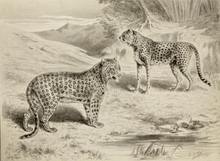
Comparative illustration of a leopard (left) and chetah (right)
The cheetah's paws have semi-retractable claws (known only in three other cat species: the fishing cat, the apartment-headed cat and the Iriomote cat), offering actress grip in its high-speed pursuits. The ligament structure of the chetah's claws is the same as those of other cats; it only lacks the sheath of skin and fur present in other varieties, and therefore, with the exception of the dewclaw, the claws are e'er visible. The dewclaw is much shorter and straighter than that of other cats.
Adaptations that enable the cheetah to run equally fast as it does include large nostrils that allow for increased oxygen intake, and an enlarged centre and lungs that piece of work together to circulate oxygen efficiently. During a typical chase, its respiratory rate increases from 60 to 150 breaths per minute. [14] While running, in addition to having expert traction due to its semi-retractable claws, the cheetah uses its tail as a rudder-like means of steering[ commendation needed ] to allow it to make abrupt turns, necessary to outflank prey animals that ofttimes make such turns to escape.

Different truthful big cats of subfamily Pantherinae, the cheetah can purr as it inhales, but cannot roar. By dissimilarity, the big cats can roar but cannot purr, except while exhaling. The cheetah is nonetheless considered past some to be the smallest of the big cats. While it is often mistaken for the leopard, the cheetah does have distinguishing features, such as the aforementioned long "tear-streak" lines that run from the corners of its eyes to its oral fissure, and spots that are not "rosettes". The thinner body frame of the cheetah is also very different from that of the leopard.
The cheetah is a vulnerable species. Of all the big cats, it is the least able to adapt to new environments. It has always proved difficult to breed in captivity, although recently a few zoos have managed to succeed at this. One technique has been to introduce a dog as a playmate and guard dog to enable a captive cheetah to feel less threatened. [25]
Once widely hunted for its fur, the cheetah now suffers more from the loss of both habitat and prey.
The cheetah was formerly considered to be peculiarly archaic among the cats and to have evolved approximately 18 million years ago. However, new research suggests the last mutual antecedent of all 40 existing species of felines lived more than recently than nearly 11 million years ago. The aforementioned research indicates that the cheetah, while highly derived morphologically, is not of specially ancient lineage, having separated from its closest living relatives (Puma concolor, the cougar, and Puma yaguarondi, the jaguarundi) around v 1000000 years agone. [17] These felids have not changed appreciably since they beginning appeared in the fossil tape.
Morphs and variations [edit]
King cheetah [edit]

A king cheetah showing its distinctive coat design
The king cheetah is a rare mutation of the cheetah characterized past a distinct fur pattern. It was first noted in what was then Southern Rhodesia (modern-day Zimbabwe) in 1926. In 1927, the naturalist Reginald Innes Pocock alleged it a split species, simply reversed this decision in 1939 due to lack of bear witness; only in 1928, a peel purchased by Walter Rothschild was found to be intermediate in pattern between the male monarch chetah and spotted chetah and Abel Chapman considered it to exist a colour course of the spotted cheetah. Xx-two such skins were found between 1926 and 1974. Since 1927, the king cheetah was reported v more times in the wild. Although strangely marked skins had come from Africa, a alive king cheetah was not photographed until 1974 in South Africa'south Kruger National Park. Cryptozoologists Paul and Lena Bottriell photographed one during an trek in 1975. They besides managed to obtain blimp specimens. Information technology appeared larger than a spotted cheetah and its fur had a different texture. There was another wild sighting in 1986—the commencement in seven years. By 1987, thirty-8 specimens had been recorded, many from pelts.
Its species status was resolved in 1981 when rex cheetahs were born at the De Wildt Cheetah and Wild animals Eye in South Africa. In May 1981, two spotted sisters gave birth there and each litter contained one male monarch cheetah. The sisters had both mated with a wild-defenseless male from the Transvaal expanse (where king cheetahs had been recorded). Further male monarch cheetahs were afterwards born at the Centre. It has been known to exist in Republic of zimbabwe, Botswana and in the northern office of South Africa'south Transvaal province.
In 2012, the crusade of this alternative coat pattern was found to be a mutation in the gene for transmembrane aminopeptidase Q (Taqpep), the same gene responsible for the striped "mackerel" versus blotchy "classic" patterning seen in tabby cats. [26] The mutation is recessive and must be inherited from both parents for this pattern to appear, which is i reason why it is so rare.
Other color variations [edit]
Other rare color morphs of the species include speckles, melanism, albinism and grayness coloration. Most have been reported in Indian cheetahs, particularly in captive specimens kept for hunting.
The Mughal Emperor of Bharat, Jahangir, recorded having a white chetah presented to him in 1608. In the memoirs of Tuzk-e-Jahangiri, the Emperor, says that in the tertiary year of his reign, "Raja Bir Singh Deo brought a white chetah to evidence me. Although other sorts of creatures, both birds and beasts have white varieties ... I had never seen a white chetah. Its spots, which are (usually) black, were of a blueish color, and the whiteness of the body also inclined to bluishness." This suggests a chinchilla mutation which restricts the amount of paint on the hair shaft. Although the spots were formed of blackness pigment, the less dense pigmentation gives a hazy, grayish effect. Besides every bit Jahangir's white cheetah at Agra, a report of "incipient albinism" has come from Beaufort West according to Guggisberg. [27]
In a letter of the alphabet to "Nature in Eastward Africa", H. F. Stoneham reported a melanistic chetah (black with ghost markings) in the Trans-Nzoia District of Kenya in 1925. Vesey Fitzgerald saw a melanistic cheetah in Zambia in the company of a spotted chetah. Red (erythristic) cheetahs have dark tawny spots on a golden groundwork. Foam (isabelline) cheetahs have pale crimson spots on a pale groundwork. Some desert region cheetahs are unusually stake; probably they are better-inconspicuous and therefore better hunters and more likely to brood and pass on their paler colouration. Blue (Maltese or grey) cheetahs have variously been described every bit white cheetahs with grey-blueish spots (chinchilla) or pale grey cheetahs with darker grey spots (Maltese mutation). A chetah with hardly any spots was shot in Tanzania in 1921 (Pocock); it had only a few spots on the cervix and dorsum, and these were unusually pocket-sized. Some other cheetah with this color-morph was photographed in Republic of kenya in 2012. [28]
Range and habitat [edit]

There are several geographically isolated populations of cheetah, all of which are establish in Africa or southwestern Asia. A pocket-sized population (estimated at nearly fifty) survive in the Khorasan Province of Iran, where conservationists are taking steps to protect them. [29]
It is possible, though doubtful, that some cheetahs remain in India.[ citation needed ] There have also been several unconfirmed reports of Asiatic Cheetahs in the Balochistan province of Pakistan, with at least one dead animal existence discovered recently. [thirty]
The chetah thrives in areas with vast expanses of country where casualty is abundant. The cheetah likes to live in an open biotope, such as semidesert, prairie, and thick brush, though it can be establish in a variety of habitats. In Namibia, for example, information technology lives in grasslands, savannahs, areas of dense vegetation, and mountainous terrain.
In much of its erstwhile range, the cheetah was tamed by aristocrats and used to hunt antelopes in much the same way every bit is still washed with members of the greyhound group of dogs.
Reproduction and behavior [edit]
Females accomplish maturity in twenty to 20-4 months, and males around twelve months (although they exercise not unremarkably mate until at to the lowest degree three years sometime), and mating occurs throughout the year. A study of cheetahs in the Serengeti showed females are sexually promiscuous and often have cubs by many unlike males. [31]

Females give birth to up to nine cubs after a gestation menstruation of ninety to xc-eight days, although the average litter size is 4. Cubs counterbalance from 150 to 300 thousand (5.3 to 10.6 oz) at birth. Dissimilar another cats, the cheetah is born with its feature spots. Cubs are as well born with a featherlike underlying fur on their necks, called a drape, extending to mid-back. This gives them a mane or Mohawk-type appearance; this fur is shed as the cheetah grows older. Information technology has been speculated this mane gives a cheetah cub the appearance of the honey badger (ratel), to scare away potential aggressors. [32] Cubs leave their mother between xiii and 20 months after nascence. Life span is up to twelve years in the wild, but up to twenty years in captivity. The rate of cub mortality varies from expanse to area, from 50% to 75%, [eleven] and in farthermost cases such as the Serengeti ecosystem, up to ninety%. In comparing to the Serengeti, the survival rate of cheetah cubs in the Kgalagadi surface area was seven times higher. [33]
Dissimilar males, females are alone and tend to avoid each other, though some mother/daughter pairs have been known to be formed for modest periods of time. The cheetah has a unique, well-structured social society. Females live alone, except when they are raising cubs and they raise their cubs on their own. The kickoff eighteen months of a cub's life are of import; cubs must learn many lessons, because survival depends on knowing how to hunt wild prey species and avert other predators. At eighteen months, the female parent leaves the cubs, who then grade a sibling ("sib") grouping that volition stay together for another half-dozen months. At about two years, the female person siblings leave the group, and the young males remain together for life.
Territories [edit]
Males [edit]

Males are frequently social and may group together for life, ordinarily with their brothers in the same litter; although if a cub is the only male person in the litter then two or three lone males may form a group, or a solitary male may join an existing group. These groups are chosen coalitions. In i Serengeti, 41% of the developed males were solitary, 40% lived in pairs and 19% lived in trios. [34]
A coalition is vi times more likely to obtain an beast territory than a lone male, although studies have shown that coalitions continue their territories just every bit long as lone males— between four to iv and a half years.
Males are territorial. Females' home ranges can be very large and a territory including several females' ranges is impossible to defend. Instead, males choose the points at which several of the females' abode ranges overlap, creating a much smaller space, which can be properly defended against intruders while maximizing the chance of reproduction. Coalitions volition endeavor their best to maintain territories to find females with whom they volition mate. The size of the territory also depends on the available resources; depending on the part of Africa, the size of a male's territory tin can vary profoundly from 37 to 160 km2 (14 to 62 sq mi).
Males mark their territory past urinating on objects that stand out, such as copse, logs, or termite mounds. When male cheetahs urine-mark their territories, they stand less than one meter away from a tree or rock surface with the tail raised, pointing the penis either horizontally backward or lx° up. [35] The whole coalition contributes to the olfactory property.[ further explanation needed ] Males volition endeavour to kill whatsoever intruders, and fights issue in serious injury or death. [36] [37]
Females [edit]

Unlike males and other felines, females do not establish territories. Instead, the area they alive in is termed a home range. These overlap with other females' home ranges, often those of their daughters, mothers, or sisters. Females always hunt alone, although cubs will accompany their mothers to learn to hunt in one case they reach the age of five to six weeks.
The size of a dwelling range depends entirely on the availability of prey. Cheetahs in southern African woodlands take ranges equally small equally 34 kmii (xiii sq mi), while in some parts of Namibia they can reach one,500 km2 (580 sq mi).
Vocalizations [edit]
The cheetah cannot roar, simply ranks among the more than vocal felids. Several sources refer to a wide variety of cheetah vocalizations, but well-nigh of these lack a detailed acoustic description which makes it difficult to reliably assess exactly what terms refer to exactly what vocalizations. A short review of the terminology encountered is institute in. [38] Some of the vocalizations listed in the literature are:
- Chirping: When a cheetah attempts to discover another, or a mother tries to locate her cubs, it uses a loftier-pitched barking called chirping. The chirps made past a cheetah cub sound more than similar a bird chirping, so are termed chirping, too.
- Churring or stuttering: This voice is emitted by a cheetah during social meetings. A chatter tin exist seen as a social invitation to other cheetahs, an expression of interest, doubt, or appeasement or during meetings with the opposite sex (although each sex churrs for different reasons).
- Growling: This vocalization is often accompanied by hissing and spitting and is exhibited by the chetah during annoyance, or when faced with danger.
- Yowling: This is an escalated version of growling, normally displayed when danger worsens.
- Agonistic vocalizations: a combination of growls, moans, hisses and the "trademark" cheetah spit, which is virtually often accompanied by a forceful "mitt hitting" on the ground. [38]
- Purring: This is made when the cheetah is content, usually during pleasant social meetings (more often than not between cubs and their mothers). A feature of purring is that it is realized on both egressive and ingressive airstream, every bit seen and heard on online video and audio. [39] [40] [41] [42] [43] [44]
Diet and hunting [edit]

A cheetah suffocating an impala
The cheetah is a carnivore, eating by and large mammalian herbivores nether 40 kg (88 lb) and that which specialise in eating C3 plants, [45] including the Thomson's gazelle, the Grant's gazelle, the springbok, impala and blesbok. The young of larger mammals such as wildebeests and zebras are taken at times, and adults too, when cheetahs chase in groups. Guineafowl and hares are also prey. Ostriches are also taken on occasion. In Iran, cheetahs prey on the Chinkara, Goitered gazelle, ibexes and wild sheep. [46]
While the other large cats often hunt by night, the cheetah is a diurnal hunter. Information technology will, nonetheless, chase on moonlit nights during the full Moon as well, where visibility is excellent. [47] It hunts usually either early in the morning or later in the evening when it is not too hot, but there is still plenty light.
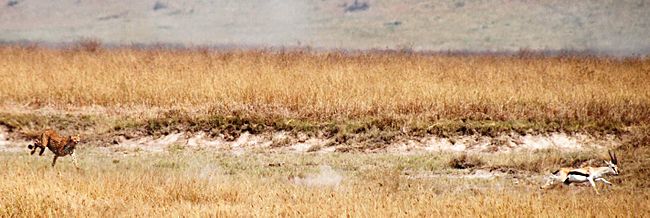
The cheetah hunts by vision rather than by scent. Prey is stalked to within 10–30 one thousand (33–98 ft), then chased. This is ordinarily over in less than a minute, and if the cheetah fails to make a take hold of apace, information technology will give up. The chetah has an average hunting success rate of effectually 50%. [14] Cheetahs can run at a very high speed; in just 2 seconds they can accomplish a speed of 75 kilometers per hour. The estimated top speed of the cheetah ranges from 90 to 128 kilometers per hour. Cheetahs refuse to run when their body temperature reaches twoscore.five °C. [48]
A documentary video shot at 1200 fps documenting the movement of a cheetah over a set run
Running at very high speeds puts a slap-up bargain of strain on the cheetah'southward torso. When sprinting, the cheetah'due south body temperature quickly elevates. If it is a hard hunt, it sometimes needs to remainder for half an hour or more.
The cheetah kills its prey by tripping it during the hunt, and then bitter it on the underside of the throat to suffocate it; the cheetah is non strong enough to break the necks of most prey. The bite may also puncture a vital artery in the neck. So the cheetah proceeds to devour its catch as quickly every bit possible before the impale is taken past stronger predators.
Data from 367 runs by three female and two male person adults, with an average run distance of 173 g, showed that hunting cheetahs tin can run 58 miles (93 km) per hour. [49] [fifty] A contempo written report that followed five African cheetahs indicated that cheetahs relied most heavily on dispatch. Most chases involved extreme maneuverability more than speed. The study indicated that cheetahs seemed to rarely run close to threescore mph or more; on nearly hunts they reached 30 to 35 mph, merely they accelerated and changed management much more than rapidly than any other land animal. [51]
The diet of a cheetah depends on the expanse in which it lives. For example, on the Eastward African plains, its preferred prey is the Thomson'due south gazelle. This small-scale antelope is smaller than the cheetah, which makes it an appropriate prey. In contrast, in Kwa-Zulu Natal, the main species of the chetah'southward casualty preference is the significantly larger nyala, which can weigh upwards to 130 kg (290 lb) in the male person. [52] Cheetahs look for individuals that have strayed some altitude from their group, and do not necessarily seek out old or weak ones.
Interspecific predatory relationships [edit]
Despite their speed and hunting prowess, cheetahs are largely outranked past other large predators in well-nigh of their range. Because they have evolved for brusque bursts of farthermost speed at the expense of their power, they cannot defend themselves confronting most of Africa's other predator species. They usually avoid fighting and will surrender a kill immediately to even a single hyena, rather than risk injury. Because cheetahs rely on their speed to obtain their meals, any injury that slows them downwards could essentially be life-threatening.
A cheetah has a 50% chance of losing its kill to other predators. [14] Cheetahs avert contest by hunting at different times of the solar day and past eating immediately after the kill. Due to the reduction in habitat in Africa, cheetahs in contempo years take faced greater pressure from other native African predators every bit bachelor range declines.[ citation needed ]
The chetah'south mortality is very high during the early on weeks of its life; up to 90% of cheetah cubs are killed during this time by lions, leopards, hyenas, African Wild Dogs, or even by eagles. Cheetah cubs often hibernate in thick castor for safety. Mother cheetahs will defend their young and are at times successful in driving predators away from their cubs. Coalitions of male person cheetahs can likewise chase away other predators, depending on the coalition size and the size and number of the predator. Because of its speed, a healthy adult cheetah has few enemies. [53]
Relationship with humans [edit]
Economic importance [edit]
Cheetah fur was formerly regarded as a status symbol. Today, cheetahs take a growing economical importance for ecotourism and they are too institute in zoos. White Oak Conservation in Yulee, Florida, which maintains a significant population of cheetahs, has cited that captive management presents challenges considering of health, nutrition and socialization of the cats, only that these accept been overcome through collaborations among wildlife facilities. [54]
Cheetahs are far less aggressive than other felids and can be tamed, so cubs are sometimes illegally sold as pets.[ commendation needed ]
Cheetahs were formerly, and sometimes still are, hunted because many farmers believe that they consume livestock. When the species came under threat, numerous campaigns were launched to endeavor to educate farmers and encourage them to conserve cheetahs. Recent evidence has shown that cheetahs will not attack and eat livestock if they can avoid doing so, as they prefer their wild casualty. [45] Yet, they have no problem with including farmland as part of their territory, leading to conflict.
Taming [edit]

A tamed cheetah offered equally tribute to the Male monarch of Thebes (1700 B.C.)
Aboriginal Egyptians often kept cheetahs every bit pets, and besides tamed and trained them for hunting. (Simply not domesticated i.due east., bred nether human control.) Cheetahs would be taken to hunting fields in low-sided carts or by horseback, hooded and blindfolded, and kept on leashes while dogs flushed out their prey. When the prey was near enough, the cheetahs would be released and their blindfolds removed. This tradition was passed on to the ancient Persians and brought to India, where the practice was continued by Indian princes into the twentieth century. Cheetahs connected to be associated with royalty and elegance, their utilize as pets spreading just as their hunting skills were. Other such princes and kings kept them as pets, including Genghis Khan and Charlemagne, who boasted of having kept cheetahs within their palace grounds. Akbar the Great, ruler of the Mughal Empire from 1556 to 1605, kept as many as 1,000 cheetahs. [14] As recently as the 1930s, the Emperor of Ethiopia, Haile Selassie, was often photographed leading a cheetah by a leash.
Cheetahs are yet tamed in the modern world. One example is Burmani, who has been raised in England at Eagle Heights wild animal park from the age of 3 months. He was bred in a deer park in Germany. He is so tame that he has lost his hunting instinct. [55]
Conservation status [edit]
Cheetah cubs accept a high bloodshed charge per unit due to predation by other carnivores, such every bit the lion and hyena, and perhaps genetic factors. It has been suggested that the low genetic diversity of cheetahs is a crusade of poor sperm, nascence defects, cramped teeth, curled tails, and bent limbs. Some biologists fifty-fifty believe that they are too inbred to flourish as a species. [56] Notation, however, that they lost most of their genetic diversity thousands of years ago (see the outset of this article), and yet seem to have only been in refuse in the last century or so, suggesting that factors other than genetics are mainly responsible.

Cheetahs are included on the International Union for Conservation of Nature (IUCN) listing of vulnerable species (African subspecies threatened, Asiatic subspecies in critical state of affairs) too every bit on the Us Endangered Species Act: threatened species - Appendix I of CITES (Convention on International Merchandise in Endangered Species). Approximately 12,400 cheetahs remain in the wild in twenty-five African countries; Namibia has the most, with about 2,500. Another 50 to lx critically endangered Asiatic cheetahs are thought to remain in Iran. At that place have been successful convenance programs, including the utilise of in vitro fertilisation, in zoos effectually the world.
Founded in Namibia in 1990, the Cheetah Conservation Fund'south mission is to be the world's resource charged with protecting the chetah and to ensure its future. The organization works with all stakeholders inside the cheetah's ecosystem to develop all-time practices in research, instruction and environmental and create a sustainable model from which all other species, including people, will benefit.
The Due south African Cheetah Conservation Foundation has close links and assists in training and sharing program successes with other countries where cheetahs alive, including Botswana, S Africa, Zimbabwe, Iran and Algeria. The organisation's international program includes distributing materials, lending resources and back up, and providing preparation through Africa and the rest of the world.
Re-introduction projection in India [edit]
Asiatic cheetahs have been known to exist in India for a very long time, just as a event of hunting and other causes, cheetahs have been extinct in India since the 1940s. A captive propagation project has been proposed. Minister of Environment and Forests Jairam Ramesh told the Rajya Sabha on 7 July 2009, "The cheetah is the only animal that has been described extinct in India in the terminal 100 years. We have to go them from away to repopulate the species." He was responding to a call for attention from Rajiv Pratap Rudy of the Bharatiya Janata Party (BJP). "The program to bring back the cheetah, which brutal to indiscriminate hunting and complex factors like a fragile breeding design is adventurous given the issues besetting tiger conservation." Two naturalists, Divya Bhanusinh and MK Ranjit Singh, suggested importing cheetahs from Africa, after which they will be bred in captivity and, in time, released in the wild. [57]
However, the programme to reintroduce the African cheetahs to India has been suspended after discovering the distinctness betwixt the cheetahs from Asia and Africa, having been separated betwixt 32,000 to 67,000 years ago. [58] [59]
In popular civilization [edit]

Bacchus and Ariadne by Titian, 1523

Cheetah with Ii Indian Attendants and a Stag by George Stubbs, 1764–1765

- In Titian's Bacchus and Ariadne (1523), the god's chariot is borne by cheetahs (which were used as hunting animals in Renaissance Italy). Cheetahs were often associated with the god Dionysus, whom the Romans called Bacchus.
- George Stubbs' Cheetah with Two Indian Attendants and a Stag (1764–1765) also shows the cheetah equally a hunting fauna and commemorates the gift of a chetah to George Three by the English language Governor of Madras, Sir George Pigot
- The Caress (1896), by the Belgian symbolist painter Fernand Khnopff (1858–1921), is a representation of the myth of Oedipus and the Sphinx and portrays a animal with a adult female's head and a cheetah's trunk (often misidentified as a leopard's).
- André Mercier's Our Friend Yambo (1961) is a curious biography of a cheetah adopted past a French couple and brought to live in Paris. It is seen as a French respond to Built-in Gratuitous (1960), whose author, Joy Adamson, produced a chetah biography of her own, The Spotted Sphinx (1969).
- Hussein, An Entertainment, a novel by Patrick O'Brian set in India of the British Raj period, illustrates the practice of royalty keeping and training cheetahs to hunt antelopes.
- The volume How Information technology Was with Dooms tells the true story of a family raising an orphaned cheetah cub named Duma (the Swahili word for chetah) in Kenya. The films Cheetah (1989) and Duma (2005) were both loosely based on this book.
- Similarly, Roger Hunt successfully tames a chetah in Willard Price'south Safari Adventure, after rescuing it from an elephant pit trap. The cheetah soon befriends a German shepherd domestic dog called Zulu.
- The blithe series ThunderCats had a main character who was an anthropomorphic chetah named Cheetara.
- In 1986, Frito-Lay introduced an anthropomorphic cheetah, Chester Cheetah, every bit the mascot for their Cheetos.
- Harold and Kumar Go to White Castle has a subplot involving an escaped cheetah, which after smokes cannabis with the pair and allows them to ride it.
- Comic book superheroine Wonder Woman's principal adversary is Dr. Barbara Ann Minerva, alias The Cheetah.
- On the CGI animated testify Beast Wars: Transformers, Cheetor, 1 of the principal characters on the Maximal faction, had the fauna form of a cheetah. This was besides carried over as the fauna form of the Cheetor Hasbro transformer.
- The Japanese anime Damekko Dōbutsu features a clumsy but sweet-natured cheetah named Chiiko.
- The outset release of Apple tree Inc.'southward Mac OS 10 was code-named "Chetah", which set the pattern for the subsequent releases existence named after large cats.
- In Visionaries: Knights of the Magical Calorie-free the character Witterquick as the totem of a Chetah and could turn into 1.
- Titled "Hunting at 60 mph", the PlayStation three game Afrika features a Chetah hunting a gazelle as the game's commencement "large game hunt".
References [edit]
- ^ Wozencraft, W. Christopher (16 November 2005). "Gild Carnivora (pp. 532-628)". In Wilson, Don E., and Reeder, DeeAnn Chiliad., eds (ed.). [http://google.com/books?id=JgAMbNSt8ikC&pg=PA532–533 Mammal Species of the Earth: A Taxonomic and Geographic Reference] (3rd ed.). Baltimore: Johns Hopkins Academy Press, ii vols. (2142 pp.). pp. 532–533. ISBN978-0-8018-8221-0. OCLC 62265494. CS1 maint: multiple names: editors list (link) CS1 maint: actress text: editors list (link) CS1 maint: ref=harv (link)
- ^ Template:IUCN2014.i
- ^ Precipitous, N. C. (1997). "Timed running speed of a cheetah (Acinonyx jubatus)". Journal of Zoology, London. 241 (3): 493–494. doi:10.1111/j.1469-7998.1997.tb04840.x.
- ^ Milton Hildebrand (1959). "Motions of Cheetah and Equus caballus". Journal of Mammalogy. xl (iv): 481–495. doi:10.2307/1376265. JSTOR 1376265. [ dead link ] Although according to Cheetah, Luke Hunter and Dave Hamman, (Struik Publishers, 2003), pp. 37–38, the cheetah'due south fastest recorded speed was 110 km/h (68 mph).
- ^ Carwardine, Mark (2008). Fauna Records. New York: Sterling. p. 43. ISBN978-1-4027-5623-eight.
- ^ Sears, Edward S. (2001). Running Through the Ages. Jefferson, North Carolina: McFarland. p. v. ISBN978-0-7864-0971-6.
- ^ Smith, Roff (ii August 2012). "Cheetah Breaks Speed Tape—Beats Usain Commodities by Seconds". National Geographic Daily News. National Geographic Society.
- ^ "Speed sensation". Nature Video Collections. BBC Nature.
- ^ "Cheetah fast facts". Zoological Social club of London. Retrieved 5 June 2013.
- ^ "Cheetah Fact Sheet". Cheetah.org. Retrieved 2013-03-30 .
- ^ a b http://www.tigerhomes.org/animal/chetah-facts.cfm
- ^ cheetah (n.d.). The American Heritage Lexicon of the English language Language, Fourth Edition . Retrieved 2007-04-sixteen .
- ^ "Acinonyx jubatus". Cat Specialist Group. Retrieved half dozen May 2014.
- ^ a b c d eastward O'Brien, Southward., D. Wildt, M. Bush (1986). "The Chetah in Genetic Peril". Scientific American. 254: 68–76. CS1 maint: multiple names: authors listing (link)
- ^ Young, T.P. and A.H. Harcourt (1997). "Viva Caughley!". Conservation Biology. 11: 831–832. doi:ten.1046/j.1523-1739.1997.011004831.x.
- ^ Johnson, Due west. E., E. Eizirik, J. Pecon-Slattery, Westward. J. Potato, A. Antunes, East. Teeling, Southward. J. O'Brien (2006). "The Late Miocene Radiation of Modern Felidae: A Genetic Assessment". Scientific discipline. 311 (5757): 73–77. doi:x.1126/science.1122277. PMID 16400146. CS1 maint: multiple names: authors listing (link)
- ^ a b Mattern, K. Y., D. A. McLennan (2000). "Phylogeny and Speciation of Felids". Cladistics. sixteen (2): 232–253. doi:x.1111/j.1096-0031.2000.tb00354.x. CS1 maint: multiple names: authors list (link)
- ^ Template:MSW3
- ^ "Agility, Non Speed, Puts Cheetahs Ahead". Scientific discipline. 340: 1271. 14 June 2013. doi:10.1126/scientific discipline.340.6138.1271-b.
- ^ "Cheetah". Animal Info. 2006-03-21. Retrieved 2013-03-30 .
- ^ Boitani, Luigi, Simon & Schuster's Guide to Mammals. Simon & Schuster/Touchstone Books (1984), ISBN 978-0-671-42805-1
- ^ "Cheetahs, Cheetah Pictures, Chetah Facts - National Geographic". Animals.nationalgeographic.com. 2012-10-25. Retrieved 2013-03-30 .
- ^ Burnie D and Wilson DE (Eds.), Beast: The Definitive Visual Guide to the World's Wildlife. DK Adult (2005), ISBN 0-7894-7764-5
- ^ "King Cheetah Fur Blueprint Mutation". Cheetahspot.com. Retrieved 2013-03-30 .
- ^ "Dogs used to calm skittish cheetahs". DailyHerald.com. 2013-02-sixteen. Retrieved 2013-03-30 .
- ^ Kaelin CB, Xu X, Hong LZ, David VA, McGowan KA, Schmidt-Küntzel A, Roelke ME, Pino J, Pontius J, Cooper GM, Manuel H, Swanson WF, Marker L, Harper CK, van Dyk A, Yue Bisong, Mullikin JC, Warren WC, Eizirik Due east, Kos Fifty, O'Brien SJ, Barsh GS, Menotti-Raymond M (2012). "Specifying and Sustaining Pigmentation Patterns in Domestic and Wild Cats". Science. 337 (6101): 1536–1541. doi:ten.1126/science.1220893. PMID 22997338. CS1 maint: multiple names: authors listing (link)
- ^ http://messybeast.com/genetics/mutant-cheetahs.html
- ^ "The lesser-spotted cheetah: Rare big cat without traditional markings sighted in wild for beginning time in nearly 100 years". Daily Postal service. London. 2012-04-25. Retrieved 2013-03-06 .
- ^ "Asiatic Cheetah". Wild Nigh Cats. Retrieved 2007-12-07 .
- ^ "Asiatic Cheetah". WWF-Pakistan. Retrieved 2007-12-07 .
- ^ "Scandal on the Serengeti: New lite has been shed on the extent of female cheetahs' unfaithfulness to their male person partners". inthenews.co.u.k.. May thirty, 2007. Retrieved 2007-12-07 .
- ^ Eaton, Randall L. (1976) A Possible Case of Mimicry in Larger Mammals. Evolution xxx(4):853-856 doi x.2307/2407827
- ^ [ane], Cheetah cub survival revisited: a re-evaluation of the role of predation, especially by lions, and implications for conservation
- ^ Richard Estes, foreword by Edward Osborne Wilson (1991) The Behavior Guide to African Mammals. Academy of California Press. Page 371.
- ^ T. M. Caro (xv Baronial 1994). Cheetahs of the Serengeti Plains: Grouping Living in an Asocial Species. University of Chicago Press. pp. 203–. ISBN978-0-226-09433-five . Retrieved 21 March 2013.
- ^ MacMillan, Dianne. Cheetahs. Books.google.com. Retrieved 2013-03-30 .
- ^ https://world wide web.youtube.com/watch?v=RxI2tjIy0kw
- ^ a b Robert Eklund. "Eklund, Peters, Weise & Munro (2012)" (PDF). Roberteklund.info. Retrieved 2013-03-30 .
- ^ Robert Eklund. "Robert Eklund's Ingressive Phonation and Speech Page". Ingressivespeech.info. Retrieved 2013-03-30 .
- ^ Robert Eklund. "Robert Eklund's Homepage". Roberteklund.info. Retrieved 2013-03-30 .
- ^ Robert Eklund. "– The felid purring site". Purring.org. Retrieved 2013-03-30 .
- ^ Robert Eklund. "Eklund, Peters & Duthie (2010)" (PDF). Roberteklund.info. Retrieved 2013-03-30 .
- ^ Robert Eklund. "Eklund, Peters, Weise & Munro (2012)" (PDF). Roberteklund.info. Retrieved 2013-03-30 .
- ^ Robert Eklund. "Eklund & Peters (2013)" (PDF). roberteklund.info. Retrieved 2013-03-30 .
- ^ a b [2], Cheetah carte du jour: wild fauna instead of cattle .
- ^ [3], Feeding environmental of the Asiatic cheetah Acinonyx jubatus venaticus in depression prey habitats in northeastern Iran: Implications for effective conservation.
- ^ Hunter, Luke & Hamman, Dave. Chetah. Struik Publishers, 2003, p. 109.
- ^ "Wild Cats of the Earth" - by Mel Sunquist and Fiona Sunquist
- ^ RVC Press Office (13 June 2013). "Groundbreaking RVC research shows wild cheetah reaching speeds of upward to 58mph during a hunt". rvc.ac.uk. Royal Veterinary College, University of London. Retrieved 2013-06-16 .
- ^ Wilson AM, Lowe JC, Roskilly K, Hudson PE, Golabek KA, McNutt JW (2013). "Locomotion dynamics of hunting in wild cheetahs". Nature. 498 (7453): 185–189. doi:ten.1038/nature12295. PMID 23765495. CS1 maint: multiple names: authors list (link)
- ^ "Cheetah tracking study reveals incredible acceleration". BBC News. 2013-06-12.
- ^ Hunter, Luke & Hamman, Dave 2003, p. 96.
- ^ Yard. W. Hayward, G. Hofmeyr, J. O'Brien & G. I. H. Kerley (2006). "Prey preferences of the cheetah (Acinonyx jubatus) (Felidae: Carnivora): morphological limitations or the demand to capture speedily consumable prey before kleptoparasites get in?". Periodical of Zoology. 270 (4): 615. doi:x.1111/j.1469-7998.2006.00184.x. CS1 maint: multiple names: authors listing (link)
- ^ "Cheetah". Retrieved 21 June 2013.
- ^ Fieldsports Britain. "Fieldsports Great britain : Rabbits with a cheetah in Essex, grouse and". fieldsportschannel.television set. Retrieved 30 Oct 2012.
- ^ Gugliotta, Guy (February 2008). "Rare Brood". Smithsonian Magazine. Retrieved 2008-03-07 .
- ^ The Times of India, Th, July 9, 2009, p. eleven.
- ^ "| Travel India Guide". Binoygupta.com. 18 May 2012. Retrieved 16 May 2013.
- ^ "Breaking: India's Plan to Re-Introduce the Cheetah on Hold". http://cheetah-sentry.com. 8 May 2012. Retrieved 13 November 2014.
Sources [edit]
- Great Cats, Majestic Creatures of the Wild, ed. John Seidensticker, illus. Frank Knight, (Rodale Press, 1991), ISBN 0-87857-965-6
- Cheetah, Katherine (or Kathrine) & Karl Ammann, Arco Pub, (1985), ISBN 0-668-06259-2.
- Cheetah (Big Cat Diary), Jonathan Scott, Angela Scott, (HarperCollins, 2005), ISBN 0-00-714920-iv
- Scientific discipline (vol 311, p 73)
- Cheetah, Luke Hunter and Dave Hamman, (Struik Publishers, 2003), ISBN 1-86872-719-Ten
- Allsen, Thomas T. (2006). "Natural History and Cultural History: The Circulation of Hunting Leopards in Eurasia, Seventh-Seventeenth Centuries." In: Contact and Exchange in the Ancient Globe. Ed. Victor H. Mair. Academy of Hawai'i Press. Pp. 116–135. ISBN ISBN 978-0-8248-2884-4; ISBN ISBN 0-8248-2884-iv
- Eklund, Robert & Gustav Peters. 2013. A comparative acoustic analysis of purring in juvenile, subadult and adult cheetahs. In: Robert Eklund (editor.), Proceedings of Fonetik 2013, the XXVIth Swedish Phonetics Conference, Studies in Linguistic communication and Culture, no. 21, ISBN 978-91-7519-582-7, eISBN 978-91-7519-579-7, ISSN 1403-2570, pp. 25–28.
- Eklund, Robert, Gustav Peters & Elizabeth D. Duthie. 2010 (tertiary edition). An acoustic analysis of purring in the cheetah (Acinonyx jubatus) and in the domestic true cat (Felis catus). Proceedings of Fonetik 2010, Lund University, 2–4 June 2010, Lund, Sweden, pp. 17–22. Download from [4] or [five].
- Gus Mills, Yard. Grand. L. Mills, Martin Harvey (2005). African Predators. Struik. ISBN1-77007-220-nine. CS1 maint: multiple names: authors list (link)
- Gus Mills (1998). Big Cats and Other African Carnivores. Struik. ISBN1-86825-920-X.
Further reading [edit]
- Caro, T. M. (1994). Cheetahs of the Serengeti Plains: group living in an asocial species. Chicago: University of Chicago Press. ISBN0-226-09433-2.
External links [edit]
 | Wikimedia Commons has media related to Acinonyx jubatus . Script error: No such module "Preview warning". |
Template:Wikispecies
- Species portrait Cheetah; IUCN/SSC Cat Specialist Grouping
- Template:Eol
- Biodiversity Heritage Library bibliography for Acinonyx jubatus
- Cheetah Conservation Fund
- Save China'south Tigers to Fund Wild Cat Conservation Worldwide
- De Wildt Cheetah and Wildlife Trust
- On the Chase With Cheetahs - slideshow by Life magazine
- False Flies and Cheating Cheetahs: measuring the speed of a chetah
- Mutant Cheetahs: information on color variants of cheetahs
- 110km/h Chetah attack gazelle Video showing cheetah's speed, running mechanics, and hyenas stealing a chetah'due south casualty.
asdflkjsalkdfjlkfsdj
Source: https://en.wikipedia.beta.wmflabs.org/wiki/Cheetah
0 Response to "White Cheetahs With Blue Eyes Scientific Name for White Cheetahs"
Post a Comment